When I heard that ESB had appointed a Managing Director to a newly formed division of the company entitled ‘Electric Vehicles’ I felt a subtle ’shift in gear’ for the motor industry. Could this mark a significant moment for the introduction of electric cars on a national scale? Are we about to dispel the notion of electric powered vehicles as a ‘concept’ to a grounded ‘reality’ that will shape the face of motoring in Ireland for the next century?
It’s only been three weeks since Paul Mulvaney (pictured above) was appointed to the position and already we’re starting to see the beginning of a new and what promises to be an exciting chapter in Ireland’s motoring history. I had an opportunity to meet with Paul and hear first-hand about ESB’s ambitions to make Ireland a significant contributor to the development of electric motoring at home and across the European Union.
We chatted about the levels of financial support on offer from the Government to those hoping to purchase an electric car and what’s being done to further the research and development of the required facilities to run them. The targets for the number of electric vehicles we can expect to see on the roads and what challenges face the ESB over the short and medium term.
It’s clear that a significant role in the success of the electric vehicle will be its purchase price and the ongoing running costs. In its recent budget the Government stated its support for the deployment of electric vehicles onto Irish roads with a VRT exemption for the next 3 years.
Also announced was that there will be a new grant for half the costs of the batteries for the first 6,000 cars on Irish roads. This is expected to be in the region of 5,000 Euro per car which represents a serious commitment to making the electric car as affordable as possible.
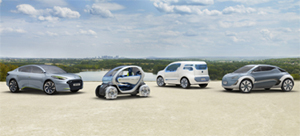
The government is on record as saying it intends to have 10% of Ireland’s national transport fleet (250,000 unites) converted to electric vehicles by 2020. It will take time to develop the infrastructure but in the shorter term they expect to have 6,000 vehicles within three years followed by a sharp increase as vehicles and the necessary charging points become more readily available.
Competition for the next generation of electric vehicles is strong between the European member states. To help Ireland get a foothold, the Government is working closely with both the manufacturers and the relevant stake holders to the extent that it has signed two separate Memorandums of Understanding with Nissan-Renault and ESB. This memo was drafted in an effort to encourage the introduction of electric vehicles to the Irish market as soon as they are available.
ESB has committed to providing the infrastructure for a radical overhaul of our electricity system so that electric vehicles, once available can be charged on the Irish system. This infrastructure whilst built and maintained by ESB will be available to all electricity providers. This is no small task and will require that ESB provide a range of charging facilities to cater for three very different requirements.

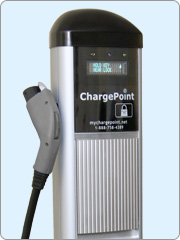
1,500 charge points to be introduced over the next three years
Paul and his team will be responsible for rolling out 1,500 charge points over the next three years and he expects to have the first active point in place outside ESB Head Office on Merrion Square in January with a further twenty or so in place by March of 2010.
‘Billing’ presents its own set of challenges and the company is looking at everything from smart cards with a standardized bill across Europe to a pre-paid model similar to mobile phone top-ups. It may even be possible to book a charging slot online and pay directly by credit card before you pull up to a charging point.
Speaking about the suitability of Ireland as a live test centre he says, “As a small island nation with one management company in charge of deploying the grid, Ireland will make an excellent test-bed for the rest of Europe”.
Critics in the past have scoffed at the idea of electric cars claiming that the source of the electricity required to charge them would be a greater pollutant than the ‘gas-guzzling’ cars we already use. Not so, says Paul. He points out that if we introduced electric cars to the grid as its generated today the reduction in CO2 emissions obtained from ‘Well to Wheel’ would be in excess of 50%. That’s before the introduction of SMART homes and technologies that would give us the ability to charge our cars overnight using excess energy generated from wind power.
Clearly committed to an environmentally sound ‘grand plan’ (ESB as a company aims to be carbon neutral by 2035), Paul mentioned that his department is already looking at ways to offer a ’second life’ to the batteries that ten years down the line will be removed from the electric cars. He hinted at the possibility of using ex-car batteries in our homes to take advantage of cheaper, cleaner electricity produced overnight and stored for use during the day.
The company has a number of next generation vehicles on order and is looking forward to sharing their experiences with anyone interested in learning more. Currently working with vehicle manufacturers, academic institutions, The Department of Energy and The Department of Transport, Paul is clearly enthusiastic about what’s to come!
I long for the day I don’t have to pay for timing belts, water pumps, oil changes etc. It will be a good day when people change to Electric. Cheaper to maintain. They are much more efficient than any engine, and as a result are cleaner, Regardless where the electricity comes from! No more freezing in my TDI as it takes 5 or 6 miles to warm up in winter, as electrics will have electric heaters. Will be much quieter than any engine. As regards price, well it’s naturally going to come at a price, Buy the car, lease the battery. It should in the long term still work out cheaper than any petrol or diesel car. The nissan Leaf comming in 2011 will be the firest real non golf cart car the public can get their hands on. And those that have wind turbines should be able to charge them for very little indeed!!!
The range of the cars remains to be seen, for instance, on cold mornings using the electric heater. Those things eat electricity! And I wonder is the figure of 160kms for the Leaf really true, or is it like some cars are quoted to get maybe 50mpg return and only get 41 0r 42?
I will keep my TDI with 171000 miles, and for sure will be the last oil burner I have. As I really believe once Electric takes off they will sell in large numbers because the advantages are many. 160kms range is more than enough range for most people and good alternatives to the 2nd family car!
As far as the government goes, they are offering ” VRT exemption for the next 3 years” which is bull because the cars won’t really be available to at LEAST 2011. VRT is a rip off anyway and would make more people think of buying new cars if they were a few grand cheaper without VRT! as regards the grant for “half the costs of the batteries for the first 6,000 cars”, good idea, but again they should extend that to many more!
Your article mentions “high speed charging points available at set locations…”
First, there is a good chance these set locations will be in a rather secure environment, to avoid vandalism 1) of the user 2) of the charging point. So these set locations are likely to be within existing petrol stations or bespoke manned “Filling” stations.
But if everybody takes at least 20 minutes to recharge their car, filling stations will quickly become jam -packed!
If I’m in a hurry and I don’t have 20 minutes (if I’m lucky and there is no jam-pack), would it be possible to purchase pre-charged batteries and leave the empty ones to the “filling” station personel for recharge and further resale to other users? Replacing empty batteries by pre-charged ones would then only take 5 minutes.
Also if the batteries are modular enough, it should be possible to lift only a small -light- battery “slice” at anyone time and avoid using too much elbow grease (useful if you are a bit arthritic).
But are these batteries modular enough to be easily lifted in stages?
Could I easily replace part of / the full battery with a pre-charged one(s) from the filling station or from my own car boot?
I personally don’t see the issue in regards charging. Electric cars at first, will really only be suitable for urban commuters and city drivers. The claimed 100 miles on a charge of the leaf is more than enough for most people, for several days. And it takes around 8 hours to charge from empty. So for most people a full charge will be much less than 8 hours!
Those fast charging points will really be for people who want to drive longer distances, in my opinion anyway. Really the E.S.B are just trying to cash in and be the next oil barrons. No one knows what they will charge for a charge lol.
I really believe electric cars won’t cost much less to (fuel) than a normal I.C.E car. By the time you rent the battery and the electricity to charge it.(maintenance will be cheaper) What will happen though is that the government will make normal cars so expensive to buy, tax and fuel that only then will people see the real savings of elecric cars. They will ban them from towns and cities, and next thing you know more and more parking spaces will be for Electric only! I have no doubt in my mind that this is the path the Irish government will take. They want electric and they will get it, and we all know what this government is capable of!!!
I am all for saving the environment, but I’m sick to death of hearing about global warming and the blame of CO2 for causing it. There are much much more serious matters to be addressed that are far more damaging to human health, for instance, Nox emissions from cars especially diesels, all the cancer causing emissions, but all you hear about is CO2. Then there is food additives, de forrestation, nano particles, nuclear waste. It’s a very long list indeed!
Before people in Ireland are so quick to believe the global warming scam. Do some research on the internet. The pro global warming scientists say the debate is over it’s official and that’s it! Well, it is far from over and there are many people who disagree with the theory and who believe we are heading for much colder times. People are brain washed totally about global warming to such an extent that people won’t question it. They believe it. The Irish government are cashing in with the introduction of carbon tax, again, putting the burden on ordinary people that need Co2 to LIVE! we already had a huge and very unfair tax on petrol and diesel and VRT. But of course if they call it carbon tax then it’s okay and they can and WIll charge what they like in the future!
Most of the institutes that research global warming are state funded, It would do people good to check out www.accuweather.com and check out Joe Bastardi, he is a meteorologist and has very interesting theorys about global warming himself. Don’t just disapprove what he says, look back at his past work. He has given very accurate LONG term forecasts, and back in July 2009 he forecasted this winter 09-10 to be very cold and he was right! I know the climate and weather are different, but check him out anyway and you will understand what I’m talking about.
I am very sorry for the long post and going off topic a bit, but I am very interested in cars and climate lol and feel very strongly about it all. It’s a shame cars have become messed up with it all!!!
Hi Shane,
I suppose if the government managed it’s finances properly, it wouldn’t have to put such insane tax on fuel and cars in the first place! Without fail every year you can be sure they will increase tax on fuel! The tax system in Ireland is much in favor of the wealthy!
What taxes will the government introduce on electric vehicles? In my opinion I doubt they will introduce much taxes on electric vehicles because the cost of purchasing carbon credits for failing to meet the Kyoto agreement will far out weigh the loss of fuel tax and V.R.T. The only way they can meet those targets is through electric vehicles, among other things including renewable energy etc!
What I find extremely disgraceful is the fact than commercial road tax and V.R.T has stayed at insanely low levels for many years
Hi Shane,
I suppose if the government managed it’s finances properly, it wouldn’t have to put such insane tax on fuel and cars in the first place! Without fail every year you can be sure they will increase tax on fuel! The tax system in Ireland is much in favor of the wealthy!
What taxes will the government introduce on electric vehicles? In my opinion I doubt they will introduce much taxes on electric vehicles because the cost of purchasing carbon credits for failing to meet the Kyoto agreement will far out weigh the loss of fuel tax and V.R.T. The only way they can meet those targets is through electric vehicles, among other things including renewable energy etc!
What I find extremely disgraceful is the fact than commercial road tax and V.R.T has stayed at insanely low levels for many years and the fact businesses can claim back the full vat of 21% on fuel, while all the time all the increases go to the average man! most if not all commercial vehicles have stayed at euro 3 and 4 emissions levels for many years and there is no push from the E.U to meet euro 5 as far as I know!
The fact that we all pollute and I’m not talking just C02, I’m talking the cancer causing emissions mean that we all should pay a fair amount of tax and there should be no exemptions for commercial users and businesses, I know the business community might disagree, of course hauliers and others might object, farmers etc but fair is fair and we all should pay equally. After all it’s for the environment!!!
What will happen if there is a massive surge in the price of oil? if it goes to €2.00 per liter or more, will the government reduce tax to compensate? I DON’T think so!
I am all for saving the environment, but the cost to the general public is way too much! Be it for cars, fuel or whatever. Ministers in the government get chauffeured around in their nice fuel guzzling vehicles at the expense of the tax payer, while they never know the pain of having to make ends meat, while the rest of us have to struggle to put food on the table or heat our homes. Shame on them!!!
I really think they are forcing more and more people to choose to hold on to their cars for longer now, and people who might have purchased new cars in the past are less inclined to now because of increased taxes on fuel.
Hello people,
I have to say that the prospect of our roads been filled with electric cars instead of oil burners is quite exciting
And it is a fact that the first electric cars were driving on the roads in Europe over a hundred years ago!! when electricity was among the preferred methods for automobile propulsion, providing a level of comfort and ease of operation that could not be achieved by the oil burning cars. We are going in this direction anyway and this is just another small step in that direction!
A resource-based economy would make it possible to use technology to overcome scarce resources by applying renewable sources of energy, computerizing and automating manufacturing and inventory, designing safe energy-efficient cities and advanced transportation systems, providing universal health care and more relevant education, and most of all by generating a new incentive system based on human and environmental concern.
Many people believe that there is too much technology in the world today, and that technology is the major cause of our environmental pollution. This is not the case. It is the abuse and misuse of technology that should be our major concern. In a more humane civilization, instead of machines displacing people they would shorten the workday, increase the availability of goods and services, and lengthen vacation time. If we utilize new technology to raise the standard of living for all people, then the infusion of machine technology would no longer be a threat.
“Jacque Fresco”
I’m also sorry for getting off the topic but I felt it necessary as we also need to incorporate and encompass different ideologies with a more ethical approach and use of integrity!!
Our sociall system needs to change so that these cars are available to all,
Viva le revolution!!!!
B
Why don’t people look at the Chevy Volt. It goes 230 miles on a charge and it looks very nice as a car. The problem with the Leaf is it does not look like a real car. It’s very small. European electric cars are ugly. People have to look for america for the way in electric cars. I have driven the chevy volt and it is an amazing car. The pickup is amazing.
Do you know if the credit will apply to electric motorbikes as well or is it just for cars?
Ok it’s been a while now and There has been an update as regards the Nissan Leaf.
Nissan announced a good while ago now, that you won’t rent the battery. You buy the car and the battery at a cost of €30000. That’s a lot, but not for the technology really. Nissan estimate Gen II Leaf will cost much less and have a range of over 300 miles.
I can see the range not been a problem as there have been huge advances in batteries especially using silicon nanowire technology. It hasn’t been commercialised yet. It was estimated in 2007 that it would take 5 years to bring this new battery to the market, so that leaves at least 2 years before we see it in any car. So far using silicon nanowires there has been an improvement of up to 4 times the capacity of normal lithium batteries, the technology itself has a theoretical 10 times the capacity potential. Even 4 times is good enough. And they estimate the batteries will be good for 1000 + cycles, and that’s full cycles from full to empty and doesn’t include partial cycles!
So if the Leaf can go for an estimated 100 miles, 4 times the capacity would make it go for 400 miles and if they can get 10 times the capacity from that battery would be 1000 miles! And with battery cycles of 1000+ that will mean they will last 1 hundred thousand miles for a range of 100 miles for the leaf (depending on it’s battery technology) or 1 million miles if a thousand miles range @ 1000 cycles. using a battery with silicon nanowire technology. Maybe other technologies will come about in the future too!
For now though if I was to spend the money, I would go with the Opel Ampera with the generator. But as a 2nd car that only does school runs or local driving, then the Leaf is ideal. The Ampera is rumoured to cost around €40000 and that’s damn expensive. I don’t know, but look at the Prius for depreciation. You can get an 08 for aroung € 16000, From around €27000 new! That is a real bargain especially when you can get 50+ mpg from a petrol automatic, which is what I get out of my 03 A4 automatic! Some people can get over 70 mpg if driven right with the Gen II prius, but it requires you to get to know how the hybrid system works.
Anyway the biggest problem will be fast charging these high capacity batteries, even with fast chargers it could take well over 5 hours to charge, unless they make faster chargers lol which will need massive amounts of electricity. Or all day on the home charger! It seems that batteries will not be a problem in the near future, only charging!
It seems Hydrogen is not a bad idea after all, only the fact it takes massive amounts of electricity to make it, which might be better off putting into batteries
I think they need to hurry up and get fusion working, that’s the answer to all our energy problems. ![]()
Are you a Senior PHP Developer? – We’re Hiring! Don’t miss out on this ‘once in a lifetime’ opportunity to become part of a young dynamic team at Ireland’s premiere automotive data provider.
At Motorcheck we receive a steady stream of comments from consumers who feel that they might have stumbled across an internet scam.
A study by Motorcheck.ie shows that as many as 1 in 5 cars for sale in Ireland may have been clocked. RTE’s Nine O’Clock News picks up the story.
Motorcheck went along armed with a fully charged digital camera and a pair of comfortable shoes to capture the amazing cars on show at this years event.
A recent investigation by BBC NI has uncovered a rise in the practice of ‘car clocking’.
Every year over 300,000 cars exchange hands in Ireland.
Over the past few months, there’s been a noticeable increase in the number of people calling Motorcheck HQ with stories of their cars being repossessed.
Ireland’s quickest and most accurate VRT Calculator
Motorcheck: New blog post - Mini is The Cleanest Car in Ireland: Motorcheck.ie examines the CO2 output of over 89,000 cars r... http://t.co/IFQn3Lpn
2 days agoMotorcheck: I'm hiring! Senior PHP Developer at Benchmark Automotive - Ireland #jobs http://t.co/wosDJYs5
2 days agoMotorcheck: Toyota Ireland has had a great start to 2012 with 3,422 passenger vehicles sold in January, positioning them as ... http://t.co/Zdscu6aB
2 days agoMotorcheck: On their Summer services to France, Irish Ferries is promoting what they call the 'best down payment deal' offer... http://t.co/kBda5QgB
2 days agoMotorcheck: SIMI has welcomed the process whereby they can make submissions on the government review of VRT and Road Tax for... http://t.co/kDYiktyI
2 days ago
Ray Hall
December 21, 2009 at 3:31 pm #
That is one very interesting article, I look forward to seeing how many people will actually buy an electric car in 2010 and how quickly the infrastructure is put in place.
Next will be the pricing of charging up your electric car, will it cost the price of a fill at the garage, or will there be a standard price right across Europe.
Then there is the back up and service for these cars, who is going to repair them, will the AA and RAC still be able to do roadside repairs if not what will be the standard charges for these repairs, and will there be accessible garages throughout the country.
In my opinion Electric Cars are a great idea but only if there is a FULL INFRASTRUCTURE in place to deal with all the problems that will arise, unlike Gas powered vehicles which are probably as good for the environment but few garages supply a gas refueling point, and those that do charge almost the same price as petrol, making drivers no better of for doing the conversion.