How Much Is Driving Costing You in Ireland?
- 21 Apr 2026
- in Help & Advice
- by Michael Rochford
Toll increases, a higher carbon tax rate, and rising fuel prices have all landed in the same year. Here is what the numbers look like, where the hidden costs catch drivers out, and what you can do to reduce them.
Driving in Ireland has always carried costs beyond the price of fuel. But 2026 has brought a convergence of increases that is worth understanding clearly before you budget for a commute, plan a car purchase, or consider switching vehicles.
Three things have changed at once: motorway tolls have risen, carbon tax has increased again as part of its scheduled path to €100 per tonne, and fuel prices have spiked sharply following events in the Middle East. Each one alone would be manageable. Together, they add up faster than most drivers have accounted for.
Toll Increases in 2026
Transport Infrastructure Ireland revised motorway toll rates for 2026. The increases are not large on a per-journey basis, but they accumulate significantly for regular commuters.
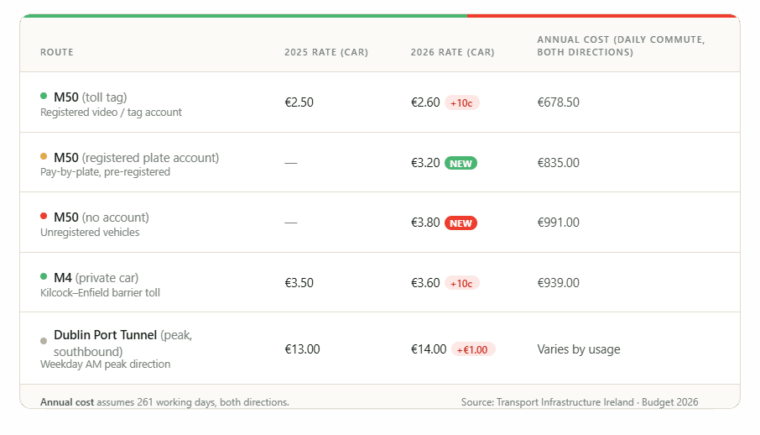
The difference between paying with a tag and paying with no account on the M50 is €1.20 per crossing which equates to €312 per year for a daily commuter. That gap alone is one of the most overlooked costs in Irish motoring.
Carbon Tax - Where it Stands in 2026
Carbon tax was introduced in Ireland in 2010 at €15 per tonne of CO₂. It has been increased in every Budget since 2019 and now stands at €71 per tonne for 2026, on a legislated path to €100 per tonne by 2030 (Department of Finance, October, 2025).

Unlike pump prices, which move with the oil market, carbon tax is fixed by legislation and increases every year regardless of what crude oil does.
Fuel Costs in Ireland in 2026
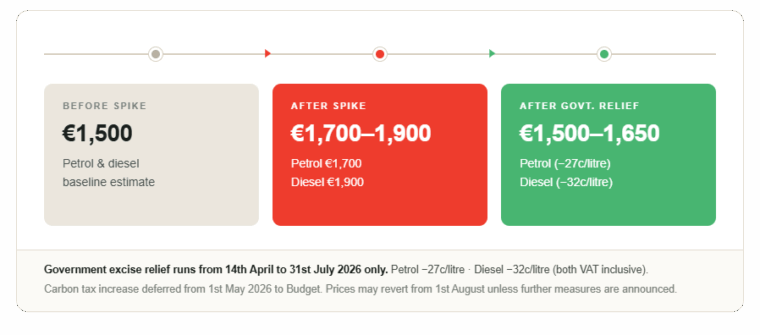
Fuel prices in Ireland have risen sharply following the outbreak of conflict in the Middle East, which triggered a significant spike in global crude oil prices. Before the spike, a driver covering 16,000km per year was paying around €1,500 annually. Current prices have pushed that to approximately €1,700 for petrol and €1,900 for diesel.
Diesel has been hit harder than petrol for two distinct reasons. First, diesel is more exposed to crude oil market movements because it is more widely used in shipping, haulage, and industry globally, when demand pressure builds, wholesale diesel prices rise faster than petrol. Second, carbon tax applies equally to both fuels per litre, but because diesel already carried a higher base price before the spike, the same carbon tax addition represents a larger share of what you pay at the pump. Diesel drivers are feeling the current crisis more acutely, and that gap will widen further as carbon tax continues to rise toward €100 per tonne by 2030.
In response, the Government has introduced a package of temporary excise reductions. From midnight on 14th April 2026, excise on petrol has been reduced by 27c per litre (VAT inclusive) and excise on diesel by 32c per litre (VAT inclusive), running until 31st July 2026. The planned carbon tax increase, scheduled for 1st May, has also been deferred until the Budget. These measures provide short-term relief at the pump, but they are temporary. From 1st August 2026, prices will revert unless further measures are announced.
The Mistakes That Make Driving Cost More Than it Should
Most of the avoidable cost in Irish motoring in 2026 comes from a small number of easily fixed errors.
- Using the M50 without a toll tag or registered account. This can cost motorists up to €312 more per year than the tag rate for a daily commuter.
- Budgeting for a used diesel purchase based on fuel costs alone, without factoring in that carbon tax will continue to rise to €100 per tonne by 2030.
- Underestimating annual toll costs when calculating whether a commute is affordable. A daily M4 return can add €939 per year before fuel is considered.
- Assuming a more economical car will automatically reduce tolls. Toll costs are fixed per journey regardless of what type and model of car you drive.
How to Reduce the Cost of Driving
Fuel, tolls and carbon tax are all increasing, but there are practical steps that can reduce what you pay without changing your car. For drivers looking to go further, our guide on how to lower your carbon footprint when driving covers additional ways to reduce both your costs and your emissions.
Tolls
- Register a toll tag. The annual saving for a daily M50 commuter is significant.
- Work from home one or two days per week where possible. Each day avoided saves the full return crossing cost.
- Check whether an alternative route avoids tolls without adding significantly to your journey time before committing to a new commute pattern.
Fuel
- Check and maintain tyre pressure. Under-inflation increases fuel consumption measurably.
- Remove unnecessary weight from the car, roof boxes and unused cargo add to fuel use on every journey.
- Reduce motorway speed from 120 km/h to 110 km/h enables fuel consumption to drop noticeably.
- Anticipate traffic further ahead to reduce unnecessary braking and re-acceleration, particularly on commuter routes.
- Keep the engine properly serviced. A well-maintained engine runs more efficiently.
Car Running Costs
If rising fuel and toll costs are making you reconsider your current vehicle, the running cost picture matters as much as the purchase price. A diesel that looks affordable to buy may carry increasing carbon tax exposure as rates rise toward €100 per tonne by 2030. An electric vehicle avoids fuel costs and carbon tax entirely, though toll costs remain the same for all vehicles.
Lower Driving Costs Start With the Right Car
Running costs are only part of the picture. A used car that looks right on paper can carry history that adds unexpected cost, outstanding finance, previous write-offs, mileage discrepancies, or import issues that weren't declared.
A MotorCheck car history check gives you the full background on any vehicle before you commit. That decision is worth making carefully. Run a car registration check at MotorCheck before you buy.
Your Questions About Driving Costs in Ireland Answered
How much is the M50 toll in 2026?
The M50 toll for a private car in 2026 is €2.60 with a toll tag, €3.20 with a registered plate account, or €3.80 with no account. For a daily return commuter, the annual cost ranges from €678.50 with a tag to €991 with no account.
How much carbon tax is on diesel and petrol in Ireland in 2026?
Carbon tax in Ireland stands at €71 per tonne of CO₂ in 2026, adding approximately 20c per litre to the cost of both petrol and diesel. It is scheduled to rise to €100 per tonne by 2030.
What is the cheapest way to pay the M50 toll?
Registering a toll tag is the cheapest way to pay the M50 toll, at €2.60 per crossing in 2026. Using the road with no account costs €3.80, €1.20 more per crossing, or up to €312 more per year for a daily commuter.
How much does it cost to drive in Ireland per year in 2026?
For a typical driver covering 16,000km per year, fuel costs currently run to approximately €1,700 for petrol or €1,900 for diesel following the Middle East-driven price spike. A daily M50 commute adds €678 - €991 in tolls depending on payment method, and carbon tax accounts for approximately €200 - €250 of the annual fuel bill. It is worth noting that the Government has introduced temporary excise reductions of 27c per litre on petrol and 32c per litre on diesel, which apply from 14th April to 31st July 2026 and will reduce pump costs for drivers during that period. From 1st August, prices are expected to revert unless further measures are announced.
Will carbon tax on fuel keep rising in Ireland?
Yes. Carbon tax in Ireland is on a legislated schedule of annual increases and is planned to reach €100 per tonne of CO₂ by 2030. The current rate is €71 per tonne, up from €15 per tonne when it was introduced in 2010.
Do electric vehicles pay motorway tolls in Ireland?
Yes. Toll charges apply to all vehicles regardless of fuel type. Electric vehicles avoid fuel costs and carbon tax entirely but pay the same toll rates as petrol and diesel cars.
 by
by