
Vehicle Registration Tax or ‘VRT’ as it’s known has been a bone of contention for Irish motorists since it was introduced in 1993.
Originally designed as a replacement for Irish excise duty charges that were no longer possible under the EU single market, VRT is now part and parcel of every car purchase in the Republic of Ireland.
VRT has a direct effect on the ‘List Price’ of a new vehicle as well as any car (New or Used) being imported from abroad. It’s effects don’t stop there – as the recent calamity in the used car market demonstrates, VRT has a substantial influence on the residual value of a used car (some 1.9 million of them currently on Irish roads).
A recent crackdown by Customs and Revenue officers in the northern counties where a stand-off developed between Customs officials and a Donegal Woman prompted one Irish man to set up a group on Facebook aptly named “Ban VRT Now“. At the time of writing the group has 11,247 members as well as local political support.
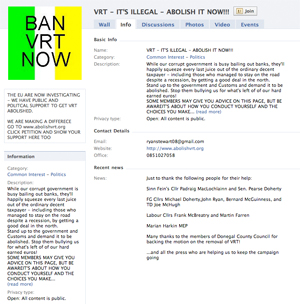
The man behind the movement, Ryan Stewart is campaigning hard to have VRT abolished in favour of a user-based system of taxation. Speaking to Motorcheck.ie, Ryan said that “Our government needs to accept that VRT is never again going to reach the 1.4 billion that it did in 2007. If they accept the detailed proposals that we have presented them with we could stabilise the tax base across all cars to a fairer ‘usage based’ policy as opposed to new car sales which we can see today are highly volatile“.
Ryan’s battle is being fought on three fronts. Politically, Ryan is campaigning at at local level to have VRT abolished and has delivered 29 out of 29 Donegal County Councillors supporting a motion to get rid of VRT. Assisting the campaign at EU level is MEP Marian Harkin who has taken his proposals to Brian Lenihan for consideration. Practically, Ryan has taken his case to Dublin castle and met with Revenue officials in an effort to ensure that that due process will be afforded to everyone suspected of evading the tax.
In a recent update to his facebook discussion Ryan writes ”We have seen some extremely heavy handed tactics applied, particularly in Donegal…in regard to officials overstepping the mark more often than not and not applying their own rules properly, or consistently. They are criminalising ordinary people, who are trying to make the best of a bad situation in the midst of a recession. They have discretion at their disposal and have leaned toward turning the screw on people, rather than using this discretion to allow people the opportunity to comply, or appeal genuine failures of this procedure.“
While Ryan argues that VRT is an illegal tax, a report prepared by Denis Murphy for the Commission on Taxation states, ‘The EU has commented that although VRT is legal it is totally contrary to the spirit of the single market and has recommended that it be phased out over a 5 to 10 year period‘.
Whilst it may be ‘unpopular’ this doesn’t mean that it’s illegal. A Revenue spokesperson pointed out to Motorcheck.ie that Ireland is only one of sixteen european members that impose VRT. i.e. Denmark, Spain, Greece, Italy, Ireland, Netherlands, Austria, Portugal, Finland, Hungary, Latvia, Malta, Slovenia, Cyprus and Poland.
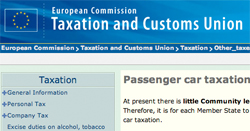
The official legal position in Europe can be found on the Commission’s website here where it states “At present there is little Community legislation, or harmonisation of national fiscal provisions, applied by the Member States in the area of passenger car taxation. Therefore, it is for each Member State to lay down national provisions for the taxation of these cars. The few pieces of legislation currently in force mainly cover the cross-border aspects of car taxation”.
As VRT is applied to the 50,000+ used cars purchased in the North of Ireland and the UK annually, many arguments against the tax focus on the cross border aspects but Revenue point out that in Ireland as elsewhere there is NO tax on crossing of a border. The tax is on the registration of the vehicle.
So is it legal? Yes. Is it liked? No.
In 2005, the European Commission made a proposal to for the abolition of car registration taxes over a transitional period of five to ten years.
At the launch of the proposal the Commission said “The Member States’ revenues would not be affected if the gradual abolition of registration taxes is accompanied by a parallel increase of annual circulation taxes and, if necessary, other taxes. A gradual change would protect car owners from dramatic devaluations of their cars. The transitional period would also allow those Member States applying high registration taxes to make the necessary structural changes to their car tax systems.”
Other proposals included a tax refund for cars that were exported and the introduction of a CO2 element into the tax base of both annual circulation taxes and registration taxes.
The recommendation was made in July 2005. 5 years on and we see that Ireland has introduced a CO2 element into the tax base but what of the abolition of VRT? Is this being ignored?
In section 9 of its final report, the commission for taxation supported the Commission’s proposal by recommending the abolition of VRT over a longer period.
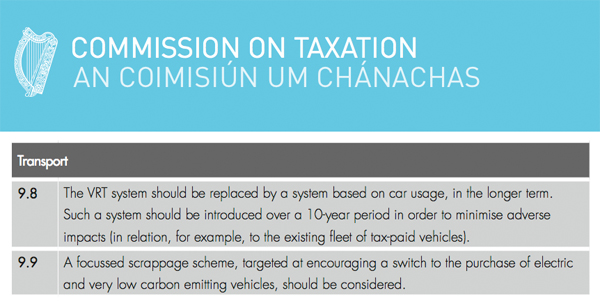
The VRT system should be replaced by a system based on car usage, in the longer term. Such a system should be introduced over a 10-year period in order to minimise adverse impacts (in relation, for example, to the existing fleet of tax-paid vehicles.
Notice the support for a focussed scrappage scheme that has since been implemented.
Any changes which could result in the fall of a used cars’ residual value would be strongly resisted by the motor industry. Many practitioners still blame the introduction of CO2 based taxation for its collapse in recent years and would be slow to support the introduction of significant changes without careful consideration.
However, there are those that believe the abolition of VRT would mean greater sales of newer, environmentally cleaner cars thus benefitting the industry. Ryan Stewart believes that the Government could reform the tax base and offer support to motor dealers experiencing a fall in residual values without losing revenue in the medium term.
It’s difficult to predict how and when VRT will be abolished (or replaced?) but with growing resentment it’s likely that it will continue to be a hotly debated topic for quite a while.
Hi Shane,
Thanks for getting in touch – just want to make a point on this though – at present, VRT is a national tax, and we understand that it is ‘legal ‘ on that basis. In correspondance we have received from the EC, they have informed us that they are launching an official investigation into how VRT is applied in Ireland, citing ’serious concerns’ about the legality of the application of VRT, pertaining to the calculations of OMSPs, fines and enforcement, double taxation, etc. They state, which we agree with, that ‘it is under the competency of member states to charge any additional taxes which they deem fit, although it is also under these competencies that member states ensure that these taxes are compatible with EU law.’
The way we see it is that thay are not compatible with EU law. That seizure of a vehicle is disproportionate as the value of the tax liability is much lower than the value of the car, that it is the enforcement of VRT which is illegal, and how Revenue calculate the OMSP on imports, and the elements of double taxation, as VAT is charged on an OMSP with VRT already charged, and that during enforcement there is no due process, without facing a minimum of €2500 for obstruction for challenging a decision of a Customs officer who is not qualified to assess the value of a vehicle. The facts are that if the government did this correctly, there would be no question of legalities, just the fact that it a very unpopular tax, which still does not make it right.
As I work in the leasing industry I for one would be very concerned at any proposed changes that might affect the residual value of vehicles.
The change to CO2 based VRT in July 2008 resulted in a drop in residuals of up to 50% and whilst for the consumer it’s bad, for those of us who have fleets of cars underwritten it is catestrophic. Whilst most garages have by now cleared their stock that was affected by this drop in value, leasing companies are, on a daily basis taking losses on cars that were unwritten three and four years ago. This will continue until mid 2011 after which we will be dealing with cars with CO2 based VRT.
Should VRT be abolished completely, the losses we are experiencing will be exacerbated and the cars due back in the next few years will also be overvalued – a situation the industry cannot afford and will not be able to take.
If any discussion on this issue takes place then the interests of businesses who either own (garages) or have a residual interest in used cars must be taken into account and Bob’s suggestion of compensating industry (I would suggest refunding the VRT element equivelant to that applicable on importing a car at present) must be implemented or face the probablility that companies who have clung on for the past two years, will go out of business and cost 0,000’s of jobs.
Any discussions on this issue must include the Vehicle Leasing Association of Ireland and it’s members.
PS. Anyone know why do we need insurance, NCT and road tax discs on our cars? Surely technology is now there that ensures if you don’t have (a) valid insurance and (b) valid NCT(if applicable) then you can’t get a tax disc. If they were linked we could dispense with the need for two of the above bits of paper stuck to windscreens!
Fined 2,500 Euro in circuit court today. Driving english reg while my car in for repairs. This was an appeal as was not represented in district court 2 months ago and fined 5,000. Thinking of writing to customs to see if they will reduce this further. I don’t have the money for the fine. Any idea what discression do they have and who do i write to?
If it’s been handed down in circuit court – I’m not a solicitor – but I doubt that there is much that you can do, although it would be interesting to hear the full facts. You can get my contact details from the website. There are certain procedures that revenue and customs are supposed to follow. You can download their enforcement manual from the website.
Here’s a thing I’ve often wondered!
I am a married women living and working here in Wexford.
My husband lives, works, pays tax and is originally from Co. Down. (He comes home every Friday morning and leaves for work every Monday morning.)
His car is taxed and insured in NI and my own car is taxed and insured in ROI.
Can I, as his spouse buy a car for myself in the North and what would be the position regarding VRT? (We had a great time explaining to the Customs and Excise as to why my husband’s northern registered car is down here most weekends but all was in order!)
After a long time thinking about it I think that it would be better if they just keep the V.R.T. At the end of the day the money will be got in other ways, higher car tax, more tax on fuel + more C02 tax on fuel, which will mean anyone who drives long distances from the country to Dublin every day will be screwed! I would rather buy a 2nd hand car and have cheaper fuel, which really is the greater cost of motoring. Eliminating VRT and raising fuel tax won’t make people buy new cars. Driving 30000+ miles a year means we pay around 3500 Euros in diesel. If fuel goes up much more then I think many people will be forced to quit their jobs! That’s why I am not in favour of more tax on fuel or pay as you drive etc. VRT no VRT, we will end up paying it anyway! They are already talking about more tolls. Where will it end? The Government is desperate to find money any way it can now, wait until the budget!
it’s crazy I bought uk reg , car 1991 toyota with nearly 200,000 on the clock. was forced to pay 1.180 euro duty. my insurance company valued the car at 1000. Customs valued it at over 4000. I asked could i appeal and was told yes but that i would not likely be successful. never again.
Are you a Senior PHP Developer? – We’re Hiring! Don’t miss out on this ‘once in a lifetime’ opportunity to become part of a young dynamic team at Ireland’s premiere automotive data provider.
At Motorcheck we receive a steady stream of comments from consumers who feel that they might have stumbled across an internet scam.
A study by Motorcheck.ie shows that as many as 1 in 5 cars for sale in Ireland may have been clocked. RTE’s Nine O’Clock News picks up the story.
Motorcheck went along armed with a fully charged digital camera and a pair of comfortable shoes to capture the amazing cars on show at this years event.
A recent investigation by BBC NI has uncovered a rise in the practice of ‘car clocking’.
Every year over 300,000 cars exchange hands in Ireland.
Over the past few months, there’s been a noticeable increase in the number of people calling Motorcheck HQ with stories of their cars being repossessed.
Ireland’s quickest and most accurate VRT Calculator
Motorcheck: New blog post - Mini is The Cleanest Car in Ireland: Motorcheck.ie examines the CO2 output of over 89,000 cars r... http://t.co/IFQn3Lpn
2 days agoMotorcheck: I'm hiring! Senior PHP Developer at Benchmark Automotive - Ireland #jobs http://t.co/wosDJYs5
2 days agoMotorcheck: Toyota Ireland has had a great start to 2012 with 3,422 passenger vehicles sold in January, positioning them as ... http://t.co/Zdscu6aB
2 days agoMotorcheck: On their Summer services to France, Irish Ferries is promoting what they call the 'best down payment deal' offer... http://t.co/kBda5QgB
2 days agoMotorcheck: SIMI has welcomed the process whereby they can make submissions on the government review of VRT and Road Tax for... http://t.co/kDYiktyI
2 days ago
Bob Flavin
June 28, 2010 at 5:13 pm #
VRT should be abolished, it wouldn’t take long for the 2nd hand market to filter through at the lower prices. But it will never happen, the Government is far too greedy, It will just be a name change e.g. VRT to Carbon Tax.
We pay too much for driving in this country, an inadequate public transport system and bumbling politicians mean we all pay through the nose for our freedom.