The €5,000 EV VRT Relief Ends in December: What It Means If You're Buying An Electric Car In Ireland
- 16 Sep 2026
- in Featured
- by Michael Rochford
The short version
- Battery electric cars get VRT relief of up to €5,000, applied automatically by Revenue when the car is registered.
- It applies to new cars and to used imports alike, because it is granted at first registration in Ireland. The SEAI grant is the one restricted to new cars.
- An OMSP at or below €40,000 means the relief usually wipes out the VRT bill entirely, so you pay €0.
- Between €40,000 and €50,000 the relief tapers away. Above €50,000 there is none at all.
- The relief is confirmed in law only until 31st December 2026. Nothing beyond that has been announced.
- Budget 2027 lands on 6th October 2026, which leaves under twelve weeks between the decision and the cut off.
Up till now, the Irish Government has been subsidising the price of almost all electric cars on sale. Not only through the Electric Vehicle (EV) purchase grant from the SEAI (Sustainable Energy Authority of Ireland) which started out at €5,000 before being reduced in 2023 to €3,500, but also through other methods.
Reduced rates of Benefit in Kind (BIK) taxation for company car drivers is one of the biggest incentives granted electric cars, and of course there’s the lowest possible rate of €120 a year in motor tax for all zero-emissions vehicle, whether you’re driving a tiny Dacia Spring or a hulking Range Rover Electric.
However, one of the biggest and best incentives has been the rebate on VRT, or Vehicle Registration Tax, which takes up to €5,000 in purchase tax off the price of an electric car. Given that VRT, essentially a holdover from the pre-European Union days when Ireland used to charge hefty import tariffs on any cars made outside the State, is often considered one of the most unfair and hated taxes around, that's a big bonus.
The bad news is that it is, or at least might be, coming to an end on the 31st of December this year.
How the VRT relief on electric cars works
VRT is charged at the point of a vehicle's registration in the State, at a rate of between seven per cent and 41% of the OMSP of the car. OMSP is Open Market Selling Price, and it's one of the nasty little tricks built into the VRT system to try to stop Irish consumers picking up bargain cars abroad and importing them. No matter what price you pay for a used car you're importing, the Revenue Commissioners will have a notional price for which that car would have sold in Ireland, and will charge VRT on that.
For new cars it's more straightforward. VRT is charged according to the wholesale price of the car, and because an electric car emits 0g/km of CO2, it sits in the lowest band, so VRT is charged at the lowest possible rate of 7%.
Except that for most electric cars it isn't really charged at all, thanks to the relief. Here is how the thresholds work:
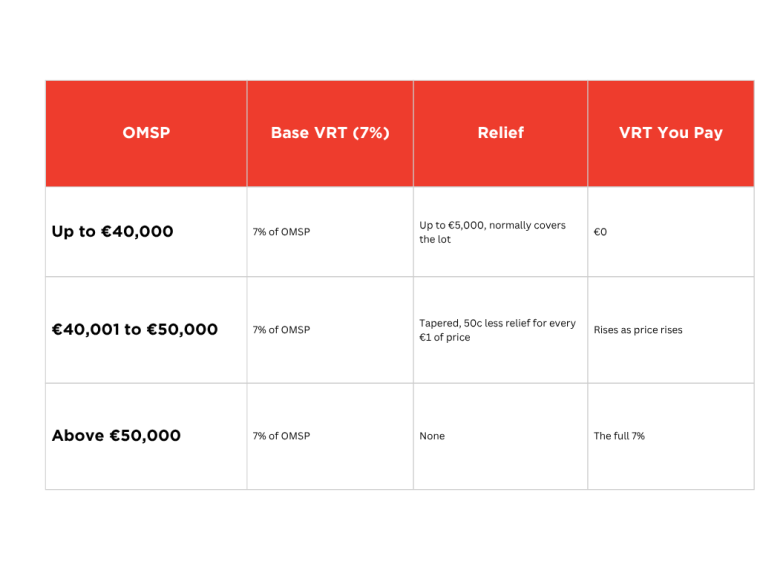
That €50,000 line is a cliff, not a slope. A car with an OMSP of €49,900 can still claim something. A car at €50,100 claims nothing.
A few other things worth knowing. The relief only applies to battery electric vehicles in Revenue's Category A (passenger cars) and Category B (light commercials), and only to series production models. Plug-in hybrids don't qualify, and the separate PHEV purchase grant was removed earlier this year. Series production electric motorcycles are a different case again: they remain VRT-exempt until 31st December 2026, with no price cap at all.
One point that trips people up: this is not a new-car-only incentive. The relief is granted at the point of first registration in the State, so a used electric car imported from the UK or the North qualifies on exactly the same OMSP thresholds as a new one in an Irish showroom. What differs on a used import is that the SEAI grant is not available, because that one is restricted to new cars.
There's no form to fill in. Revenue works out the OMSP, applies the 7%, deducts the relief and bills you the difference. If you want to know what that figure will be on a specific car before you sign anything, run it through the MotorCheck VRT calculator.
When does the EV VRT relief end?
31st December 2026. That's the date in the legislation, and there is nothing beyond it.
Back in October 2025, presenting Budget 2026, the then Minister for Finance Paschal Donohoe said the VRT relief for electric vehicles would continue until the end of this year. Every previous time the relief was due to run out, the Government extended it, albeit with modifications along the way. This time, though, there is concern that it will simply be removed, and that the prices of electric cars will rise considerably as a result. At a time of global climate crisis, when the need to de-carbonise our national transport infrastructure is more acute than ever, that could be a disastrous move.
Notably, the extension was not presented as a job finished. Donohoe framed it as another year granted in support of increasing the number of electric vehicles on Irish roads, which is the language of a policy still working rather than one that has done its work. The industry was less diplomatic. SIMI director general Brian Cooke called it extremely disappointing that the Government had not done more for the electric vehicle market, singling out the BIK changes as a tax increase for many EV company drivers.
Electric car sales in Ireland have already overtaken petrol and diesel
That argument runs into an awkward fact. According to SIMI, 9,682 new battery electric cars were registered in July alone, a 98% increase on July 2025 and the highest monthly BEV total ever recorded here. Year to date, 29,840 electric cars have been registered, up 61%, giving BEVs a 26.1% share of the new car market, ahead of hybrids on 24.6%, petrol on 20.4%, plug-in hybrids on 14.5% and diesel on 12.5%.
Is that a blip? The car industry doesn't think so. Speaking to Skoda's Irish managing director, John Donegan, he's firm in his opinion that:
“I think between what's going on in the Middle East, and the general cost of living, there's a huge focus on electric cars now, helped by the recent scrappage scheme. It's all focused car buyers' minds on EVs. The charging network is improving, and the choice in the market is improving.”
What about the €5,000 EV scrappage scheme?
The scrappage scheme Donegan refers to was a separate pilot, run through the Department of Transport rather than Revenue, and it is worth understanding because it is the one incentive that has clearly done what it was designed to do.
It offered a €5,000 grant to drivers trading in a car more than 13 years old against a new electric vehicle, stacked on top of the existing €3,500 SEAI purchase grant. When applications opened in July, the scheme hit its limit within 75 minutes, taking roughly 2,000 older cars off the road in under an hour and a half. Funding was weighted towards rural buyers, with 65%, or €6.5 million, ringfenced for applicants outside Dublin, Cork, Galway, Limerick and Waterford.
Transport Minister Darragh O’Brien has since described the pilot as “incredibly successful” and has said he is minded to run it again next year, though he stopped short of committing, saying he would review it first. His department is due to publish the scheme data shortly.
Two things to be clear about. The scrappage grant is not the VRT relief, and a decision to repeat one tells you nothing about the other. And unlike the VRT relief, the scrappage grant applied to new battery electric vehicles only, with second-hand cars excluded entirely.
What happens to EV prices if the relief goes in January
At the more expensive end of the market, nothing changes. Those cars already get no relief, so they'll cost the same in January as they do now. But for electric cars costing less than €40,000, and that's a lot of cars and a lot of variants now, prices would rise considerably.
Take the Volkswagen ID.4, the best-selling electric car in Ireland in January of this year. In its most popular form, the ID.4 comes with a 79kWh battery at a price, including the SEAI grant and the VRT relief, of €40,183. Its pre-incentive price tag stands at €46,690, so the relief is saving Irish buyers €3,007. Assuming the SEAI grant is left untouched, the price of that popular model would rise to €43,190.
The increase would, proportionally, hit buyers of more affordable models much harder. Renault's popular 5 E-Tech electric hatchback currently has a cheapest list price of €26,295, inclusive of both full VRT relief and the SEAI grant. Take away the relief and that car's price tag would jump to a much less tempting €28,380.
Here's how the relief plays out across a spread of the models currently selling in Ireland:
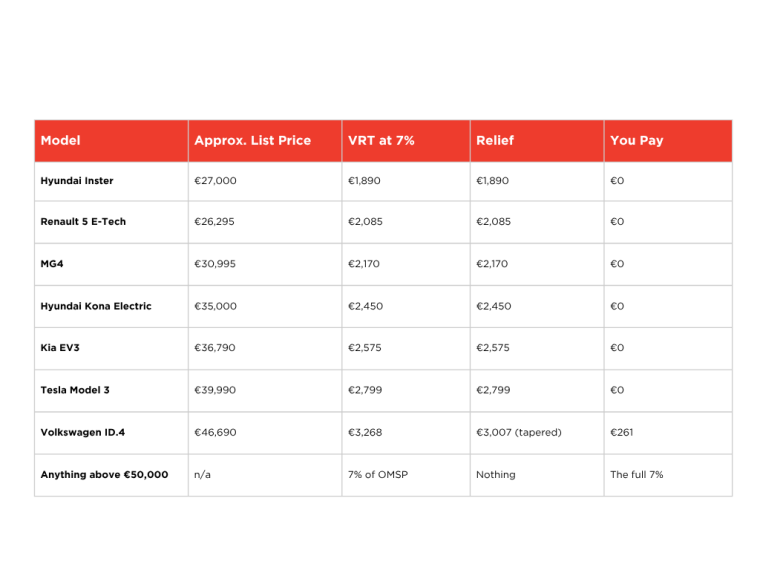
Remember that Revenue's OMSP can differ from the list price, particularly on an import, so treat these as indicative and check the specific car.
The relief also applies to importing a used electric car from the UK
One of the nice things about the VRT relief is that it's applied at the point of a vehicle's first registration in the State, and that counts for used imported cars too.
Right now the UK is awash with affordable used EVs, thanks to the need for car makers and dealers to cut prices as far as possible to meet the challenging demands of the UK's ZEV Mandate, a policy that enforces a minimum percentage of electric car sales each year. Consequently, even with post-Brexit import duties and VAT payable, there are some genuine EV bargains in the UK for Irish buyers, thanks to the relief. Take that away and once again you're taking away consumer choice.
Worth being clear about which incentive is which here, because the two get mixed up constantly. The VRT relief applies at first registration in the State, so a used EV imported from the UK or the North qualifies on exactly the same OMSP thresholds as a new car in an Irish showroom. The SEAI grant does not. That one is new cars only, with a list price between €14,000 and €60,000, and your dealer applies for it on your behalf.
So on a used import the VRT relief is the only purchase-side support you get, which is why the December deadline matters more on an import, not less. If you are buying used from the UK or the North, run a car history check first, because a cheap EV with a clocked reading or outstanding finance is not a bargain.
What it means for company car drivers
VRT relief for private buyers is tapered in a broadly similar way to BIK relief for company car drivers choosing electric power.
For all company car drivers this year there's a €10,000 reduction in the taxable value of the car, which tapers to €5,000 in 2027 and €2,500 in 2028 before disappearing in 2029. Electric company car drivers get a much bigger reduction on top of that: an extra €20,000 in 2026, which drops to €10,000 in 2027.
So in 2026, if you're driving an electric company car with a notional value of €40,000, you're only being taxed on €10,000 of it. In 2027, you'll be taxed on €25,000. There's better news elsewhere, though: since 1st January this year, zero-emission cars sit in a new A1 BIK category with rates running from 6% to 15% depending on your business mileage, the lowest rates in the system. If VRT relief is removed for private buyers, there could well be further changes to BIK too.
Will the Government extend VRT relief?
There are lessons from previous instances, some of them harsh, that show meddling with incentives is a dangerous game.
Back in 2023, when the SEAI grant was cut from €5,000 to €3,500, there was an immediate slump in new electric car sales, a slump that lasted 18 months and which seriously damaged the chances of the country hitting its original 2030 EV sales goals. Sales have recovered since, and there are those who say the drop was coincidental and more to do with there simply not being enough affordable EV models available at the time. But as ever, there's a lack of fire without smoke, so to speak.
Experts have warned against such changes in tack. Erik Figenbaum is chief research engineer at Norway's Institute of Transport Economics, and he told us:
“I think the most important lesson learned is that you need to set a target for where you want to go, when it comes to electric vehicles. And then you have to devise policies to enable you to meet the target, which usually means having some sort of incentive in place. Inconsistency is a problem. I think if you want to make changes, they should be advertised earlier, maybe you say two years from now we will start changing the incentives, not just doing it overnight in the national budget.”
Germany is another case in point. At the end of 2023 the German government made an abrupt, literally overnight decision to remove EV incentives, and sales of electric cars immediately tanked. They haven't fully recovered since.
That's the problem currently facing the Irish Government. Budget 2027, in which it will be decided whether or not to keep the VRT relief going, is set for 6th October 2026, which leaves under twelve weeks before the end of December 2026 cut off. The car industry simply can't work that fast. Vehicles that will be sold in this country in January, the most important sales period of the year for new cars, are already under construction in factories in Europe, Japan, Korea and China, and orders will have to be placed by local importers before the Budget is finalised.
A sensible option is to keep the VRT relief going for at least another year, and to announce for definite whether or not it's going to stick around rather than leaving everything until the last minute. As far as the switch to electric cars goes, buyer confidence is vital, and that confidence will ebb away fast if the Government keeps messing with incentives at short to no notice.
Should you buy before 31st December 2026?
If you're already thinking about an electric car, the arithmetic is clear:
- If the car you want has an OMSP at or below €40,000, the relief is covering your entire VRT bill. Registering in 2026 locks in a saving that might not exist in January.
- Registration date is what counts, not order date. A car ordered in November but registered in January would not qualify, so ask your dealer to confirm the registration date in writing.
- Don't assume €0. Check the figure on the specific car using the MotorCheck VRT calculator before you commit, especially if the price is anywhere near €40,000.
- Importing works the same way, because the relief applies at first registration here. The same December deadline applies to a UK or Northern Ireland buy.
- Budget 2027 on 6th October 2026 will tell you one way or the other, but it leaves very little room to act if the answer is no.
Frequently Asked Questions
Is there VRT on electric cars in Ireland?
Yes, technically. Electric cars are not exempt from VRT, they qualify for a relief of up to €5,000. On most new EVs that relief covers the whole bill, so the amount you actually pay is €0.
When does the €5,000 VRT relief end?
31st December 2026. The car must be registered in Ireland on or before that date. Anything beyond it depends on Budget 2027 on 6th October 2026.
How much VRT would I pay on a €40,000 electric car?
Base VRT is seven per cent of €40,000, or €2,800. The relief covers it in full, so you pay nothing.
How much VRT on a €60,000 electric car?
The full seven per cent, which is €4,200. There is no relief at all above €50,000.
Does the relief apply to a used EV imported from the UK?
Yes. It is granted at first registration in Ireland, so a used import qualifies on the same OMSP thresholds as a new car. The SEAI grant is the one restricted to new cars. On a GB import you will still owe VAT and customs duty on top, and the relief does not reduce either of those.
Is the €5,000 EV scrappage scheme coming back?
Possibly. The Transport Minister has called the pilot incredibly successful and indicated he may run it again next year, but no commitment has been made. It is a separate measure from the VRT relief and applied to new electric cars only.
Do plug-in hybrids get the relief?
No. It applies to battery electric vehicles only.
 by
by