UK Used Car Imports Are Rising Again But Japan Is Still Winning the Irish Forecourt
- 16 Sep 2026
- in Importing from the UK
- by Michael Rochford
Ireland is importing used cars at a pace not seen since before Brexit. According to SIMI’s registration figures, 63,815 used cars were imported in the first eight months of 2026, up 37% on the 46,661 imported over the same period last year.
The headline number is only half the story. Where those cars are coming from has changed completely, and it matters more than most buyers realise, because the country a car spent its first few years in determines what its history looks like and how easy that history is to check.
Ireland is importing used cars at a record pace
Analysis published by DoneDeal Cars, based on SIMI registration data, shows just how far the market has shifted in seven years.
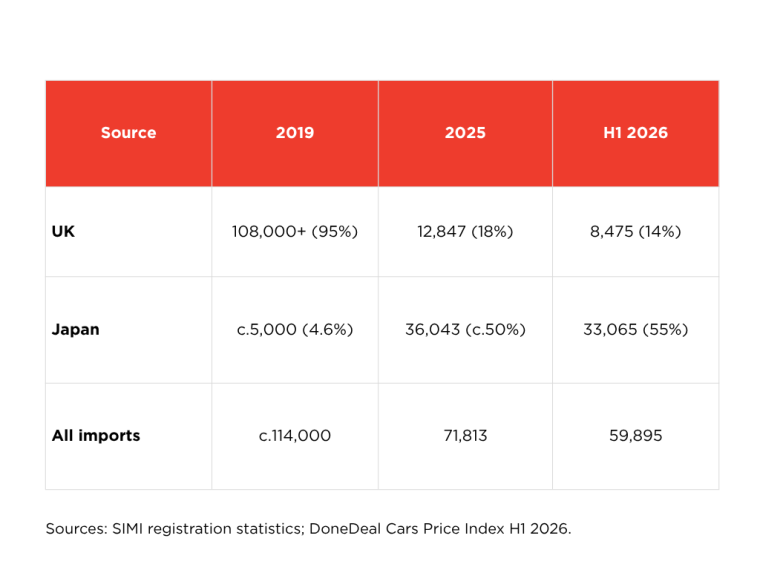

In 2019, the UK supplied 95% of every used car imported into Ireland, more than 108,000 of them in a single year. Japan was under 5% By the first half of 2026 that position had reversed: Japan accounted for 55% of imports, the UK 14%.
The UK’s falling share is not the same as falling UK volume. At 8,475 units in six months, Britain is running well ahead of the 12,847 it supplied across the whole of 2025. British stock is growing again in absolute terms. It is simply growing more slowly than a used import market that has expanded around it.
Why UK imports collapsed after Brexit
The past decade built up significant barriers for Irish buyers looking to import. Alongside the long-standing hurdle of Vehicle Registration Tax, Britain’s withdrawal from the EU in 2021 largely closed off the well-worn route of bringing in a right-hand drive model from across the Irish Sea.
Because Britain became a third country outside the European Union, VAT, previously charged only on cars younger than six months or with under 6,000km on the clock became payable again, alongside customs duty, generally charged at 10% of the purchase price plus shipping.
That left a triple charge on used imports from Britain: VAT, customs duty and VRT, which from 2019 also carried the NOx levy on diesel vehicles, introduced to discourage imports of older, more polluting stock.
Imports from the UK suffered accordingly. The 2016 Brexit vote weakened sterling to near parity with the euro, Irish buyers and dealers had pounced on the British used market, importing in such volume that there were genuine concerns used imports might overtake new car sales. The final closing of the Brexit process, and the costs that came with it, brought that free-for-all to an end. The Covid shutdowns compounded the sourcing problem.
How Japan filled the gap
Irish buyers turned increasingly towards Japan. The same VRT, VAT and customs duty costs apply, but the Japanese market treats its cars differently, and used stock there represents such good value that cars can be landed here and still priced competitively.
Dealers also rate the condition of what arrives. Paul O’Connor, who runs a Japanese import specialist firm in Dungarvan, Co. Waterford, puts the difference down to how cars are treated at either end.
“There’s not much of a car maintenance culture in Ireland. So cars of that sort of price in Ireland are often high-mileage cars, and maintained to quite a poor standard. There’s just such a culture of respect in Japan, for cars and for everything else. They look after their cars like they would their house, or even their cities. The cars that come in from Japan need very, very little work doing to them, whereas an eight-year old Irish car? Oh my god…”
The pull, he says, is a gap in Irish supply that dealers cannot fill at home.
“The main reason we have to go to Japan is because the Irish car market is crying out for clean, low-mileage sub €20-25,000 cars. At the moment, that kind of car is very hard to find on an original Irish registration.”
Most of what arrives from Japan carries a familiar European badge, Volkswagen, BMW and Audi models are all popular, which sidesteps the spare parts and anti-theft immobiliser issues that can affect some Japanese home market cars.
Why UK volumes are climbing again
We asked the Society of the Irish Motor Industry why imports of any origin remain such a fixture of the Irish market. Emma Mitchell, SIMI’s Operations Director, pointed to a structural shortage of home-grown used stock.
“Used imports have always been a feature of the car market. Since Brexit, the profile of used vehicle imports has changed, both in terms of where vehicles are imported from and the mix of engine types being brought into the market. One of the potential reasons for the level of imports is that, since 2009, new car registrations have remained below the 140,000 annual level considered necessary to maintain a healthy supply of used vehicle stock. The most effective way to address any shortage of used cars is through a stronger new car market. In the short term, increased new car sales generate trade-ins, while over the longer term they increase the supply of vehicles entering the used car market after three to four years.”
New car sales have for years fallen short of the critical mass needed to feed the used market, which is why imports carry so much of the load. What has changed for Britain specifically is the type of car now worth bringing over. One experienced dealer, who asked not to be named, pointed to the electrified end of the market.
“The demand is there for PHEV and electric cars, that only crept back after the price drops of 2023-2024, and there’s more confidence among used buyers now when it comes to PHEV and electric models. With the percentage of EV registration requirement in the UK, there is plenty of competition among car makers to get those registrations up, which has the effect of bringing prices on nearly new cars, EVs especially, back to what works in our market.”
The registration data supports that. Average emissions on UK-sourced imports have fallen from 91g to 65g of CO2 per kilometre as buyers chase the least heavily taxed stock, while Japanese imports remain overwhelmingly petrol and hybrid. The British channel is smaller than it was, but it is now weighted towards newer, cleaner, higher-spec cars.
What it means if you are buying this year

More imports means more choice, and on the whole that is good news for Irish buyers. It also means a growing share of the cars on Irish forecourts spent their early life on a database that an Irish-only check cannot see.
An increasing number of used cars on UK roads have previously been written off. That is not an automatic red flag, as some write-off categories can be safely and legally repaired and returned to the road, but it depends on the seller disclosing it and pricing accordingly. Not every seller is that conscientious, and older tricks such as clocking are still common and harder than ever to detect across two jurisdictions. UK and Irish write-off categories do not map neatly onto one another either, which makes it easy to misread what you are being told.
Spotting an import is usually straightforward:
- The Irish registration number will be much higher than normal for the county - Dublin import registrations, for example, start above 120000.
- The original UK V5C registration document should be there when you check the paperwork.
- The Irish logbook will show no previous Irish owners.
- Any service history will carry UK dealer stamps and receipts.
Identifying an import is the easy part. Establishing what happened to it before it got here is where buyers come unstuck.
Check the history before you commit
MotorCheck checks Irish and UK databases, so a car’s record either side of the Irish Sea comes back on the same report: previous write-offs, mileage discrepancies, outstanding finance and anything else on its history. With dealers even more active in the import market than private buyers, that cross-border view matters more this year than it has in a long time.
If you are importing yourself rather than buying an import off a forecourt, our VRT calculator will give you a figure before you commit.
Run a car history check before you buy.
 by
by