How Much VAT Do You Pay on a Used Car in Ireland, and When?
- 17 Nov 2026
- in Importing from the UK
- by Michael Rochford
If you buy a used car that's already registered in Ireland, you don't pay VAT as a separate bill: it's already built into the price. VAT only becomes a separate cost when you import, most often from Great Britain, where you pay 23% at import before the car can be registered. This 2026 guide covers every route, from Irish dealers to Northern Ireland and Britain, with a worked example and the paperwork Revenue asks for.
TL;DR: No separate VAT on a used car bought in Ireland, from a dealer (it's in the price under the margin scheme) or a private seller (none at all). Great Britain imports: 23% VAT on price + transport + insurance + customs duty, paid at import before registration. Duty is 10%, or 0% with proof of UK origin or Returned Goods Relief. Northern Ireland: no VAT or duty on a used car that was there before 2021 or was properly imported, but you need the paperwork. "New" cars (6 months or less, or 6,000km or less) pay 23% Irish VAT from anywhere. VRT is due on every import, and you have 30 days to register.
VAT on used cars in Ireland at a glance
VAT, customs duty and VRT are three separate charges. VAT and duty are worked out on what you paid plus transport. VRT is worked out on Revenue's valuation of the car in Ireland (the OMSP), whatever you paid. Estimate it with our VRT calculator.
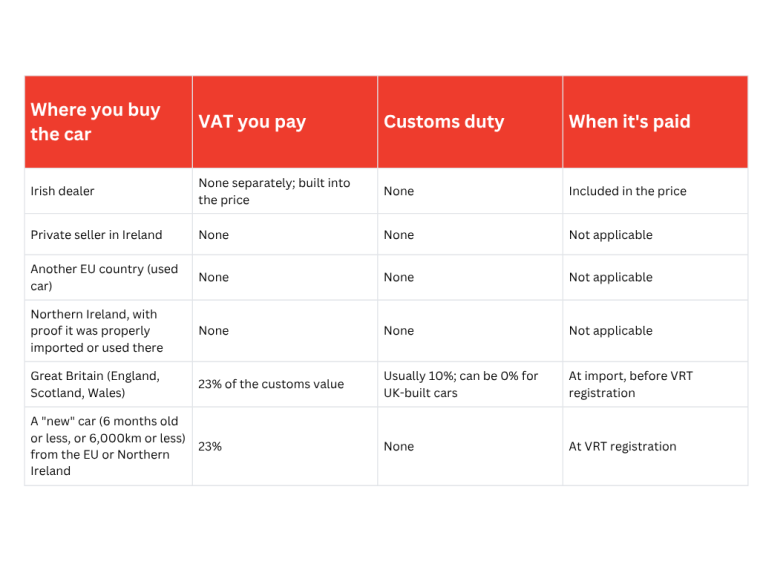
Do you pay VAT on a used car bought in Ireland?
No, not as a separate charge. VAT is paid in full when a car is first sold new, and the used price you pay later reflects that.
When you buy from an Irish dealer, they'll usually sell the car under the VAT margin scheme. That means the dealer pays VAT only on their profit (the difference between what they paid for the car and what they sell it for), and it's already included in the price on the windscreen. You won't see it as a line on your invoice.
Buying from a private seller, there's no VAT at all. A private individual doesn't charge VAT on a car they sell.
When a used car counts as "new" for VAT
Revenue treats a car as new for VAT purposes if it's 6 months old or less, or has travelled 6,000km or less (about 3,700 miles). It doesn't matter if it has been registered and driven elsewhere.
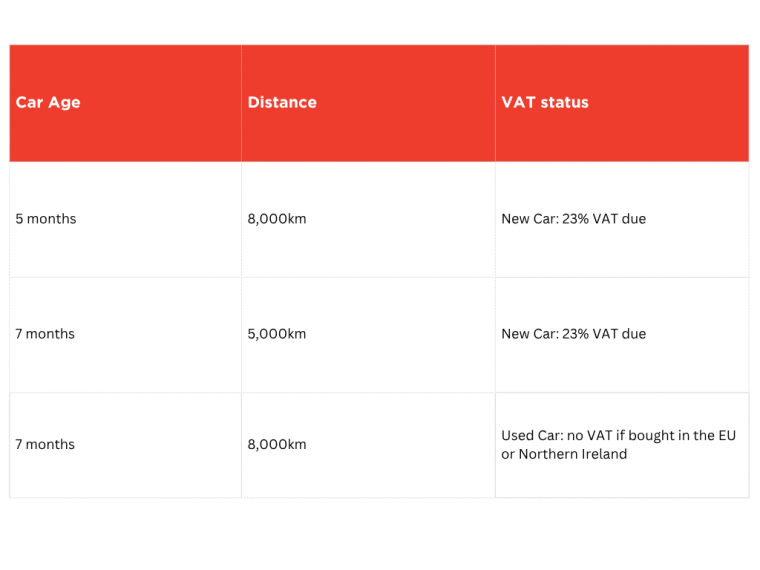
That matters most for nearly-new and ex-demo cars bought outside the State. A new car brought in from Northern Ireland or another EU country is liable for Irish VAT at 23%, normally paid when you register it. Check the age and the mileage before you agree a price.
VAT on used cars imported from Great Britain
Since Brexit, Great Britain is a non-EU country for customs purposes, so a car bought there and brought into Ireland is a full import. You'll need to:
- Complete a Customs Declaration
- Pay any customs duty due
- Pay import VAT at 23%
- Register the car and pay VRT
Import VAT = 23% × (price + transport + insurance + customs duty)
Because the duty is added first, you pay VAT on the duty too. VAT isn't charged on VRT.
Customs duty: when it's 10% and when it's 0%
Customs duty is 10% of the purchase price plus transport and insurance, unless the car qualifies for one of two reliefs.
The car was built in the UK. Under the EU-UK trade agreement, a car of UK origin pays 0% duty, whether it's new or ten years old. Origin depends on where it was made and what it was made from, not where it was registered. You'll need a "statement on origin" from the UK seller on the invoice or another document that identifies the car, or your own documentary evidence. You need to keep this as Revenue can check it after the car is registered.
The car started out in the EU. A car built in, say, Germany and used in Britain isn't UK origin, so it normally pays 10%. But if it was in circulation in the EU before it went to the UK, comes back within three years and hasn't been altered, you may be able to claim Returned Goods Relief on the duty. Import VAT is still due unless you're the person who originally took it out of the EU.
A V5C doesn't prove UK origin. In one 2024 Tax Appeals Commission case, a sales receipt, a certificate of conformity and the logbook weren't accepted, and the 10% duty stood. Get the statement on origin before you pay for the car.
You can't register the car until the Customs Declaration is done. Our step-by-step guide to importing a car from the UK covers the declaration, EORI number and MRN in detail.
VAT on used cars from Northern Ireland
A used car bought in Northern Ireland isn't treated as an import for VAT and customs purposes, so it can come into the State with no VAT and no customs duty, provided it was legally in circulation there. Under the Windsor Framework, Northern Ireland follows EU rules for goods. You still pay VRT.
There are two ways a Northern Ireland car qualifies:
- It was in Northern Ireland before 1 January 2021. Cars already there when the UK left the EU are treated as EU goods, with no customs formalities, whatever their age.
- It arrived later and was properly imported. If a car was moved from Britain after 2020 without the correct customs formalities, you can end up paying VAT and customs duty just as if you'd bought it in England.
For the second route, Revenue asks for an NI Import Declaration showing the car was imported into Northern Ireland under the Windsor Framework. If that isn't available, for example because the car has changed hands since, Revenue may accept other proof at its discretion.
Minimum proof Revenue asks for without an NI Import Declaration:
- The original V5C issued to the last registered keeper, showing they live in Northern Ireland
- A service history in Northern Ireland
- An MOT test history in Northern Ireland
Revenue checks these documents, and without them you won't be able to register the car. Ask the seller for them before you pay. A dealer in Northern Ireland who brought the car in from Britain should be able to give you the import declaration.
How much difference does it make? A worked example
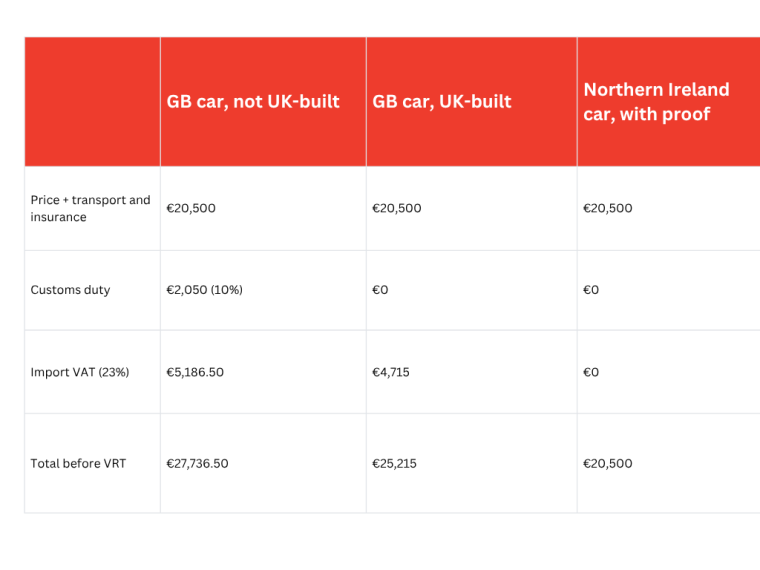
Here's an illustration for a used car costing €20,000, with €500 for transport and insurance:
On this example, the same car costs over €7,200 less from Northern Ireland than from Britain, before VRT. VRT is due whichever route you take.
When do you pay VAT on an imported used car?
For a car from Great Britain, VAT is due at import, before registration:
- Before you buy: get any proof of UK origin from the seller
- At import: file the Customs Declaration and pay customs duty and VAT. You'll get a Master Reference Number (MRN)
- Within 7 days of arrival: book your NCTS appointment
- Within 30 days of arrival: register the car and pay VRT, bringing the V5C and the declaration with its MRN
Miss the 30 days and Revenue can seize the car. That applies if a Customs Declaration is needed and isn't completed, or if the car isn't registered in time.
For a new car from Northern Ireland or the EU, the VAT is normally paid at registration instead.
Can a UK dealer take the UK VAT off the price?
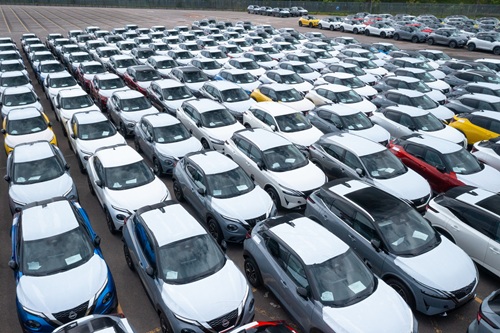
UK dealers price cars including UK VAT at 20%, either in full or on their margin. Private Irish buyers generally can't reclaim UK VAT, so check whether the price you're quoted includes it before you work out the import costs.
The UK's Second-Hand Motor Vehicle Payment Scheme lets VAT-registered dealers in Northern Ireland and EU countries, including Ireland, reclaim the VAT element on cars they buy in Britain to resell. It isn't open to private buyers, and a dealer doesn't have to pass any of that saving on.
What's changing in 2027?
Budget 2027, announced on 6 October 2026, doesn't change VAT or customs duty on cars. The 23% rate and the rules above stay the same. It does change VRT, which you pay on top:
- VRT rates go up from 1 January 2027. Rates for cars in CO2 bands 3 to 20 (anything over 80 g/km) rise by 1%. If you're importing a petrol or diesel car, registering it before the end of December 2026 avoids the increase.
- EV VRT relief is extended to 31 December 2028. Fully electric cars keep up to €5,000 off VRT for two more years.
- Northern Ireland proof was tightened in August 2026. Revenue's updated guidance asks for an NI import declaration or, failing that, the V5C plus NI service and MOT history. Older guides that mention only the V5C and MOT, or "a reasonable period" of use, are out of date.
Check the car before you check the tax
A MotorCheck report flags outstanding finance, write-offs and mileage discrepancies on Irish and UK cars. Run a car check with MotorCheck Ireland. Get the tax right and the history right. Get your car registration check report today.
Frequently Asked Questions: Car Tax
Do I pay VAT on a used car from Northern Ireland?
Not if it was in Northern Ireland before 2021, was properly imported there, or you can prove it was used there with its V5C, service and MOT history. Without that proof, VAT and customs duty may apply.
Is a car from Northern Ireland classed as an import?
Not for VAT and customs, if it was legally in circulation in Northern Ireland. It still has to be registered here and VRT paid within 30 days.
Do you have to pay VRT on a car from Northern Ireland?
Yes. VRT and the NOx levy apply to every car registered in Ireland for the first time, wherever it comes from.
What does it cost to import a car from Northern Ireland?
For a qualifying used car, the main cost is VRT and the NOx levy, plus transport. A car that's "new" for VAT purposes, or one moved from Britain without the right paperwork, adds 23% VAT.
Is it worth importing a car from Northern Ireland?
It can be, because a qualifying car avoids both VAT and duty. It's only worth it if the paperwork is in order before you pay; otherwise the saving can disappear.
What is the VAT rate on an imported car in Ireland?
23%, charged on the price plus transport, insurance and any customs duty.
Do I pay VAT on a used car from an Irish dealer?
Not separately. The dealer accounts for VAT and it's already in the price.
Do I pay VAT on a used car from Germany or another EU country?
Not if it counts as used: more than 6 months old and over 6,000km. A newer car is liable for Irish VAT when you register it.
 by