What's the Average Annual Mileage in Ireland, and What Counts as High?
- 19 Oct 2026
- in Help & Advice
- by Michael Rochford
The average private car in Ireland covered 15,196 km (about 9,440 miles) in 2023, according to the Central Statistics Office (CSO). That's the figure to hold any used car's odometer against. What the number really tells you, though, depends on where the car has lived, what fuel it runs on and how old it is.
How many kilometres are on the clock? It's the first thing almost everyone asks about a used car in Ireland. (We still say "mileage", even when we mean kilometres.) It's a fair question, because the odometer is a good first clue to how a car has been used. On its own, though, it can mislead you. Here's how to read it properly.
Quick answer
- Average in Ireland: 15,196 km a year per private car (CSO, 2023)
- Above average: more than about 20,000 km a year
- High mileage: 25,000 km a year or more
- Quick check: divide the odometer reading by the car's age in years, then compare the result with the figures above
What is the average mileage per year in Ireland?
The CSO puts the average distance driven by a private car in Ireland at 15,196 km in 2023, down slightly from 15,423 km in 2022. You'll often see 15,000 to 18,000 km quoted online, but that range is based on older data. Irish drivers have been covering fewer kilometres over the last decade, helped along by remote and hybrid working and a gradual move away from diesel.
The CSO calculates the figure from odometer readings recorded at the NCT. Cars aren't tested until they're four years old, so the figures for newer cars are estimated from the trends of older ones.
Average mileage by county in Ireland
Where a car is driven makes a big difference. Perhaps unsurprisingly, cars in Dublin cover some of the shortest distances in the country. Head out into the commuter belt and the midlands, and annual mileage climbs quickly.
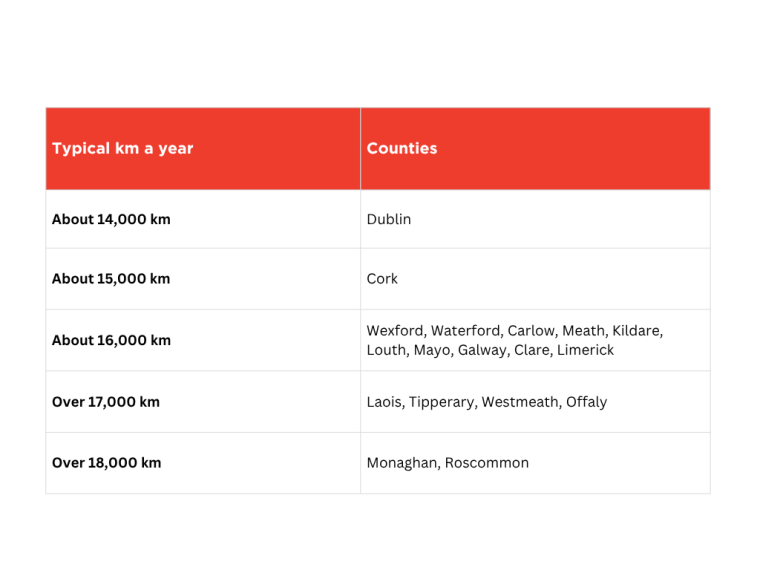
So a Roscommon car with high mileage for its age may simply reflect a long rural commute. The same reading on a Dublin car is more unusual, and worth a closer look at its history.
Average mileage by car type and fuel
The type of car matters just as much as where it's driven. A Toyota Aygo, a small 1.0 litre petrol city car, would typically show low mileage, perhaps around 8,000 km a year. A higher reading doesn't make it a bad buy, but you'll want plenty of service stamps and receipts to back it up.
A BMW 520d is the opposite. It's built to cover long motorway distances, so anything under 20,000 km a year would be a surprise. With a full service history, even a six-figure reading on a car like that shouldn't worry you.
The official figures back this up. In 2021, diesel cars in Ireland averaged 16,012 km while petrol cars averaged 9,723 km, according to the CSO. That year was affected by Covid restrictions, so the gap between the two is more telling than the exact numbers.
Why low mileage on a diesel can be a warning sign
Ireland has its own quirk here. In 2008, motor tax switched from engine size to CO2 emissions, and almost overnight the market swung towards diesel. That lasted until after 2015, when the Dieselgate scandal hit and buyers started moving to hybrids, and then to electric cars.
The problem is that the tax change pushed many people into diesels that didn't suit the way they drove. Modern diesels, especially those with a diesel particulate filter (DPF), need regular long runs to heat up and clean themselves. Drive one on short hops and the DPF can clog, and DPF repairs are expensive. Some owners removed the filter altogether, which can lead to an NCT failure further down the line.
So a used diesel with very low mileage could be hiding problems. If you're buying a diesel, you actually want to see mileage close to or above the average.
What's normal mileage for a car's age?
The total on the clock matters less than the ratio between kilometres and years. Most of us baulk at a reading over 100,000 km. Yet someone covering only slightly more than the average, say a driver in Monaghan, would pass that mark in five or six years, while the car is still in its prime.
Use this table as a quick benchmark. It's based on the Irish average of about 15,200 km a year.
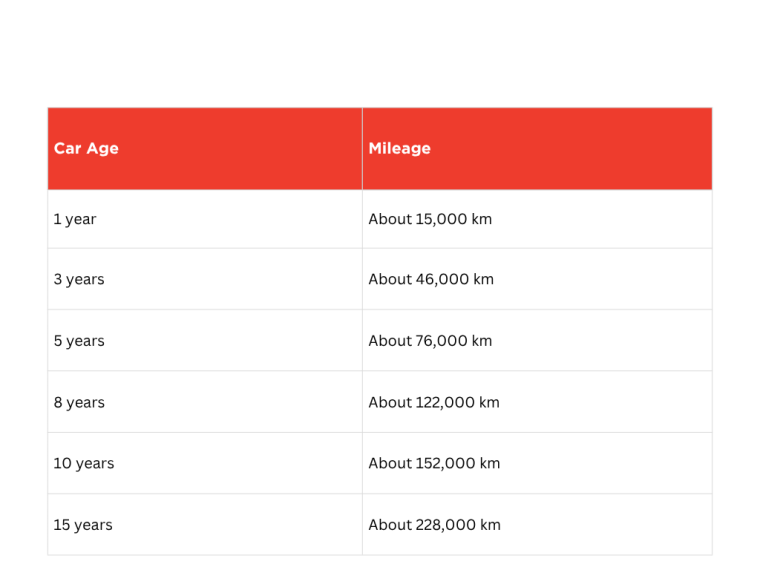
Bear in mind that newer cars tend to cover more ground than older ones, as they're often a household's main car or a company car. A three-year-old car sitting a little above the table is normal. A 15-year-old car well above it has worked hard for its living.
What counts as high mileage on a car in Ireland?
As a rule of thumb, more than about 20,000 km a year is above average, and 25,000 km a year or more is high mileage. On total distance, anything over 150,000 km deserves a careful inspection. Over 200,000 km, we'd only consider a car with a complete service history and recent work on wear parts like the brakes, tyres and clutch.
What counts as "too high" also depends on the fuel type. A diesel built for motorway driving can handle far more than a small petrol city car. For a closer look at when to walk away, see our guide to what is too much mileage on a used car. Buying a van instead? Read how much mileage is too much for a used van.
Is a high-mileage car a bad buy?
Not necessarily. There's a good argument that higher mileage can be a positive sign. A car that has been driven regularly and maintained properly has probably been reliable for its previous owners. Any major issues are likely to have been found and fixed already.
Low mileage raises its own questions. A car advertised as "pristine, low mileage" might have spent its life in stop-start city traffic, which causes more wear than steady motorway cruising. It might have sat unused for long stretches. Or the reading might not be genuine at all.
How to check a car's mileage history
Everything above assumes one thing: that the number on the clock is accurate. Even with digital dashboards, clocking (winding back the odometer) is still possible, and it's still a real problem in Ireland.
Your NCT certificate prints up to three previous odometer readings, which is a useful start. A MotorCheck car history check goes further. It compares the car's current mileage with its recorded readings from past NCT tests and other sources, so any gaps or drops stand out straight away.
Found a car you like? Check its recorded mileage history before you buy. Enter the reg for a MotorCheck report.
Only when you know the figure is accurate can you make a properly informed choice.
Does your annual mileage affect your car insurance?
Yes. Insurers ask for your estimated annual mileage because the more you drive, the higher the chance of a claim. It's worth giving a realistic figure. Underestimating to save money could cause problems if you ever need to claim, while overestimating means you may pay more than you need to. If you're not sure, check the readings on your last two NCT certificates and work out the difference.
Frequently Asked Questions on Car Mileage
Is 20,000 km a year a lot in Ireland?
It's above average, but not unusual. The Irish average is 15,196 km a year (CSO, 2023), and plenty of commuters in counties like Monaghan and Roscommon cover more. At 20,000 km a year, a well-maintained car with a full service history is still a sensible buy.
What is a good km per year for a used car?
Anywhere between about 10,000 and 20,000 km a year is normal for an Irish car. Divide the odometer reading by the car's age to get its yearly average. More important than the number itself is a consistent mileage history and a complete service record.
Is 50,000 miles a lot for a two-year-old car?
Yes. 50,000 miles is about 80,000 km, or 40,000 km a year, which is more than double the Irish average. It isn't automatically a bad buy, especially if it's an ex-company car, but check the service history carefully and expect a lower price.
What is a realistic annual mileage to put on my insurance?
Use your own history rather than the national average. Compare the odometer readings on your last two NCT certificates, or note your reading today and again in a month, then multiply by 12. Most Irish drivers land somewhere between 10,000 and 20,000 km a year.
What is high mileage for a diesel car?
Diesels are built for distance, so 20,000 to 25,000 km a year is normal for many of them. Over 200,000 km in total, check the service history closely, particularly the DPF, injectors and turbo. A diesel with very low mileage can be a bigger worry than one with high mileage.
What mileage is too high for a petrol car?
Petrol cars in Ireland cover less distance on average, so more than about 20,000 km a year is high for a small petrol car. Over 150,000 km in total, inspect it carefully, and only go higher with a complete service record.
Is it worth buying a high-mileage car?
It can be, if the price reflects the mileage and the car has a full service history. A high-mileage car that has been well looked after often makes a better buy than a low-mileage car with gaps in its history. See our guide to what is too much mileage on a used car for more.
How can I tell if a car has been clocked?
Compare the odometer with the readings on old NCT certificates and service records, and look for wear that doesn't match the mileage, such as a shiny steering wheel, worn pedals or a sagging driver's seat. A MotorCheck history report flags any mileage discrepancies against the car's recorded readings.
Sources: CSO Transport Hub snapshot, 2025; CSO Transport Omnibus 2021. Last updated: October 2026.
 by